

Best Practice by IQAC
1.Research Excellence
Practice
The institution practices a comprehensive approach to support faculty members in their research efforts. Faculty Development Programs (FDPs) are regularly conducted to educate faculty on the procedures for research publications, ensuring they are well-versed in the necessary processes. In addition, technical support is provided, giving access to the latest research tools and resources to facilitate high-quality research.
To further encourage a strong research practice, the institution offers financial support and rewards to faculty members who actively engage in research and successfully publish their work. These incentives serve as both motivation and recognition, reinforcing the importance of research within the academic environment and driving continual growth in research output.
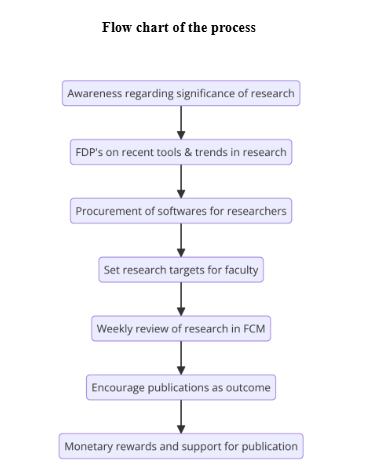
Research Process Enhancement Framework
- Awareness Regarding the Significance of Research:
The first step in enhancing research productivity is to raise awareness among faculty members about the importance of research. By understanding its significance, faculty members can appreciate the value that research adds to their academic work and professional development. - FDPs on Recent Tools and Trends in Research:
The institution organizes Faculty Development Programs (FDPs) that focus on the latest tools, trends, and methodologies in research. These programs ensure that faculty members are equipped with the skills and knowledge necessary to conduct cutting-edge research in their respective fields. - Procurement of Software for Researchers:
To facilitate high-quality research, the institution provides researchers with access to the latest software tools. This helps them to efficiently conduct their research, analyze data, and produce impactful results. - Setting Research Targets for Faculty:
Clear and measurable research targets are established for faculty members. This helps in maintaining a structured approach to research and ensures that faculty are continuously contributing to the institution’s research output. - Weekly Review of Research in FCM:
Regular weekly reviews are conducted, especially within the Faculty of Commerce and Management (FCM), to monitor the progress of ongoing research projects. These reviews allow for timely feedback and support, ensuring that faculty stay on track with their research goals. - Encouraging Publications as an Outcome:
Faculty members are encouraged to focus on producing publications as the primary outcome of their research activities. Publishing in reputable journals and conferences is seen as a key indicator of success in their research efforts. - Monetary Rewards and Support for Publication:
To further incentivize research activities, the institution provides monetary rewards and additional support for faculty members. The institution has given financial assistance for faculty members to attend workshops and FDPs related to research. This not only motivates faculty to engage in research but also ensures that they have the necessary backing to continue their work. - Regular Yoga Sessions:
IQAC’s structured yoga sessions offer students a holistic wellness tool to enhance their academic and personal well-being. By focusing on stress management, these sessions utilize breathing techniques, meditation, and physical postures to activate the body’s relaxation response, helping students manage anxiety and maintain calm. Regular yoga practice also improves concentration, memory, and cognitive function, making it a valuable resource for students to enhance focus and retain information, directly benefiting their academic performance.
Yoga promotes physical fitness, emotional resilience, and community bonding. The physical benefits include improved flexibility, strength, and cardiovascular health, supporting students through long study hours and reducing strain from prolonged sitting. The emotional benefits, like enhanced resilience and stability, equip students to handle academic pressures and transitions. With sessions scheduled at the start of each semester, IQAC is also fostering long-term health habits that support self-care and a balanced lifestyle, creating a supportive community and a positive wellness culture on campus.
- Blended Learning and Infrastructure Readiness:
IQAC’s emphasis on blended learning and infrastructure readiness aimed to seamlessly integrate online and in-person learning, making education accessible and engaging for all students. By adopting a hybrid model, IQAC equipped classrooms with technology that allowed live streaming, interactive teaching, and content sharing, ensuring that both online and in-person students received an equitable learning experience. The upgrades included high-speed internet, multimedia projectors, interactive whiteboards, and Learning Management System (LMS) platforms, which facilitated access to digital materials, lectures, and assignments from any location. Additionally, faculty were trained extensively on hybrid teaching techniques, focusing on strategies for engaging students both in-person and virtually, fostering collaboration, and effectively managing the unique dynamics of a hybrid classroom.
Faculty were encouraged to employ diverse assessment methods, such as digital portfolios and online presentations, which allowed a more comprehensive evaluation of student learning. This focus on infrastructure readiness and flexible policies not only optimized the hybrid learning experience but also ensured that the institution was prepared to handle varied teaching and assessment scenarios effectively, creating a resilient academic environment that could adapt to students’ evolving needs.
- Industry Collaborations and Experiential Learning:
IQAC’s focus on industry collaborations and experiential learning reflects a commitment to equipping students with real-world skills and insights. Through strategic partnerships with various industry sectors, IQAC facilitated both virtual and in-person internships, giving students direct exposure to professional environments and enabling them to apply theoretical knowledge to practical challenges.
In addition to internships, IQAC organized industry talks, workshops, and exposure visits, bringing industry professionals and alumni into the academic space to discuss current trends, innovations, and career paths. These interactions bridged the gap between academia and the workforce by offering students insights into industry expectations, skill requirements, and the evolving job landscape. Exposure visits to companies and industrial sites also gave students a first-hand understanding of operations, management practices, and real-time problem-solving, making learning more impactful and relevant. These experiences not only deepened students’ industry knowledge but also helped them make informed career choices, supporting a smoother transition from academic life to professional success.
- Faculty Development on Emerging Technologies and Research:
IQAC’s Faculty Development Programs (FDPs) and Management Development Programs (MDPs) were instrumental in advancing faculty competencies in emerging technologies, particularly AI tools, and in adopting innovative teaching and research methodologies. These sessions were designed to keep faculty up-to-date with technological advancements, equipping them with practical skills for integrating AI, data analysis, and digital resources into their curriculum. Training sessions covered AI tools for research, data interpretation, and personalized learning, enabling faculty to create data-driven insights and tailor their teaching to student needs. By familiarizing faculty with these tools, IQAC helped them make learning more interactive and accessible, fostering an adaptive learning environment that responds to student performance and engagement.
Beyond technological skills, these development programs introduced faculty to cutting-edge pedagogical techniques and research methodologies. Sessions focused on learner-centered approaches, project-based learning, and collaborative teaching strategies that encourage critical thinking and active learning among students. Faculty were also trained in advanced research practices, including interdisciplinary research and grant proposal writing, enabling them to expand their academic contributions and pursue collaborative research projects. These FDPs and MDPs thus strengthened teaching quality by bridging the gap between traditional methods and modern educational practices, ensuring faculty could deliver a more dynamic, impactful learning experience that prepares students for the demands of a rapidly changing world.